

At All Aboard Inclusion, everything we do is grounded in a Multi-Tiered System of Supports (MTSS)
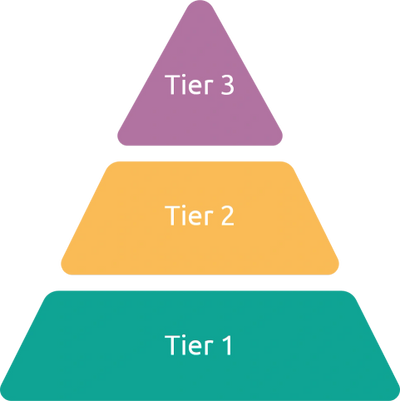
Tier 1: Building Inclusive Environments for Every Child
Tier 1 is universal. It is the foundation that benefits every child in the room. We work alongside educators in preschools and early childhood settings to build inclusive classroom environments, strengthen everyday teaching practices, and develop the tools and confidence educators need to notice and respond to variability in development early. This includes professional development, practical coaching, environmental design, and the use of our MTSS assessment tool to screen all children, identify those who may benefit from additional support, and establish a clear baseline from which progress can be tracked.
Importantly, Tier 1 is also where we begin conversations with families. When we notice a child who may benefit from further support, we walk alongside that family, sharing observations, exploring what they are seeing at home, and where relevant, supporting them through conversations about assessment, referral pathways, or funding applications such as the NDIS. Families should never have to navigate those pathways alone, and they do not have to with us. A strong Tier 1 means every child experiences a setting where they feel safe, seen, and ready to learn.
Tier 2: Targeted Support for Children with Additional Needs
Some children need a little more than what a well-designed classroom provides. Tier 2 supports are targeted, strengths-based, and delivered within the preschool day. At this level we offer small group social skills and school readiness programs, targeted consultation around specific skill areas or areas of focus, and direct coaching and strategy support for educators. We also work with preschool and childcare services to build their internal capacity by developing or strengthening a dedicated Inclusion Educator or Inclusion Coordinator role within the centre. This builds lasting capability within the service so that children are supported not just while we are there, but every day.
Throughout Tier 2, our assessment tool continues to guide the work. We use it to monitor each child's response to the strategies in place, adjust our approach when needed, and ensure that progress is visible and measurable for both families and educators. Support at Tier 2 does not require a diagnosis. It is responsive, practical, and designed to meet children and families where they are right now.
Tier 3: Comprehensive Early Intervention
Tier 3 is our most intensive level of support, designed for children who need individualised, comprehensive intervention across three or more areas of development. This is our signature embedded model, delivered directly within mainstream preschool classrooms by a team of Certified Behaviour Analysts, Therapy Assistants, and Early Childhood Educators working side by side with the preschool team. Intervention is woven into every part of the preschool day and goals are individually designed, data-driven, and deeply functional across the following skill domains:
- Group skills, including attending to instruction, participating in group learning, and following classroom routines
- Transition skills, supporting children to move between activities and environments with confidence and ease
- Play skills, building the foundations of independent, parallel, and interactive play with peers
- Social skills, developing peer interaction, turn taking, friendship, and connection
- Self-help skills, including toileting, feeding, dressing, and independence in daily living routines
- Communication skills, supporting children to express their needs, engage with others, and participate as active communicators across all settings
- School readiness skills, building the cognitive, behavioural, and social foundations children need to transition to and thrive in a school environment
Our assessment tool underpins every step of the Tier 3 program. It informs goal setting at the outset, tracks skill development across domains over time, and ensures that decisions about a child's program are always grounded in evidence rather than assumption.
Tier 3 is a wrap-around service. Families are not just informed, they are genuinely central to everything we do. We provide monthly parent workshops covering a range of topics relevant to raising and supporting a child with additional needs. We support families with parent advocacy, helping them understand their child's rights, navigate systems, and feel confident speaking up for their child. Every child receives a formal Individual Education Plan (IEP) with goals co-designed with families and educators, and a comprehensive written report every six months documenting progress, celebrating growth, and planning the next steps forward together.
This is not a pull-out model. It is real inclusion, built on real evidence, in the environments where children belong.